
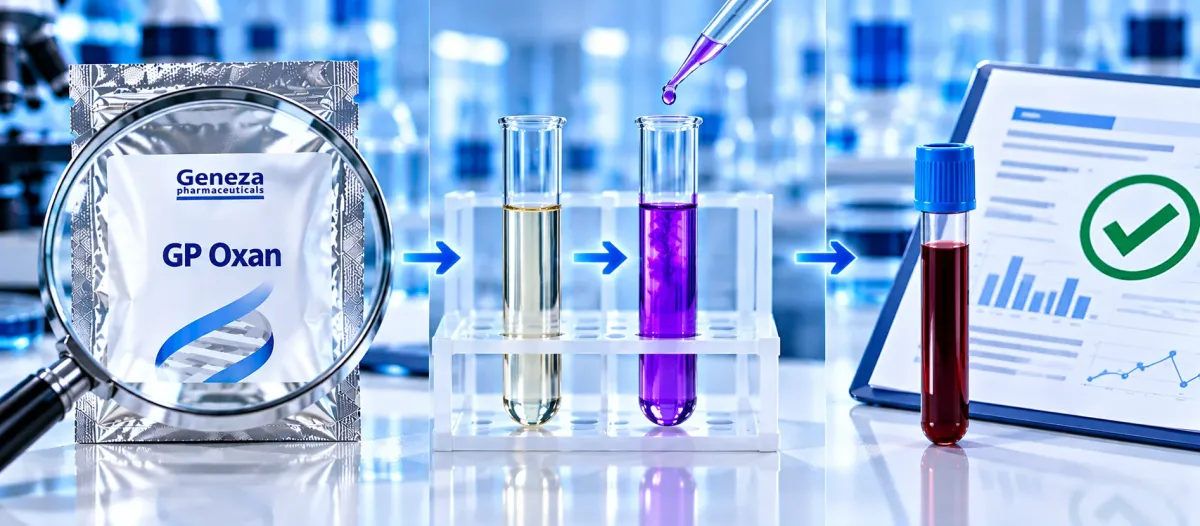
Geneza Product Authenticity: How to Check GP Products
Geneza product authenticity: why third-party code checks prove little, and the four checks that work: seller history, packaging, reagent tests and blood work.
Why Authenticity Is the Main Question
A Geneza product authenticity check is harder than it should be. Popular GP products such as GP Test Cyp 250 and GP Oxan are copied, several look-alike websites claim to be the official Geneza store, and some of those sites offer a code check that proves nothing. The brand itself has a decent record in independent lab tests, so the practical risk is not the label but whether a given vial or pouch is one of its products.
No single Geneza product authenticity test settles it. What works is a sequence of checks, each cheap, that together make a fake very unlikely to get through.
Seller, packaging, reagent kit, blood work. Each step removes a different kind of fake, and none of them depends on a website run by someone you cannot identify.
Geneza Pharmaceuticals Verification Codes
Search results now include several pages offering a Geneza verification code check or product verification by batch number. The problem is ownership. A code system protects buyers only when the manufacturer runs the database and prints the codes. When the checker sits on a site that also sells GP products, or on a recently registered domain with a slightly different spelling, the operator can print codes on counterfeit packaging and confirm them in their own database.
For Geneza, no code-check site has been shown to be controlled by the manufacturer. A valid result from one of them is not evidence either way, and an invalid one may only mean the product came from a different reseller. The four checks below do not rely on any site.
Step 1: Vet the Seller
For Geneza product authenticity, the seller decides most outcomes. Reviews that report fake GP products almost always name an unknown shop or a new website; long-running resellers with public feedback rarely produce such reports.
Seller signals
History
Years of independent forum feedback
New domain, no footprint
Price
In line with established stores
40 to 60 percent below market
Claims
Presents itself as a reseller
Claims to be the official manufacturer
Payment and support
Clear policy, reachable support
Pressure, unusual payment methods
Step 2: Inspect the Packaging
A Geneza product authenticity check on packaging means comparing the product with recent photos of the same item and batch posted by long-time users, not with photos on the seller's own page. Check the GP logo and font, label alignment and print quality, batch and expiry format, vial cap and crimp colour for injectables, and the pouch or box seal for tablets. Geneza packaging has changed over the years, so an older design is not automatically fake; the question is whether the product matches other buyers' photos of the same batch.
Step 3: Reagent Test
Colorimetric reagent kits, sold for steroid identification, change colour depending on the compound. They confirm that a vial labelled testosterone contains a testosterone ester and not something else, and that GP Oxan tablets react as oxandrolone. They do not measure the dose. Reddit and forum users regularly post reagent results for GP products, which makes it easy to compare colours.
Step 4: Blood Work
For testosterone products, blood work is the strongest check a buyer can run. Total testosterone two to three weeks into a steady dose shows whether the product is real and roughly dosed; a result near baseline on a supposed 500 mg a week is a clear fail. For orals, indirect markers help: GP Oxan lowers SHBG and HDL, and GP Stan does the same, so a panel with no change at all after several weeks is a warning sign. Independent lab analysis, such as the community-funded SIMEC AG tests covered in our Geneza Pharmaceuticals review, is the gold standard but costs more than most buyers spend per vial.
Red Flags of a Fake GP Product
- 1The seller also claims to be the official Geneza manufacturer and runs its own code checker.
- 2Packaging that differs from recent community photos of the same batch.
- 3Oil that is cloudy, has particles, or causes unusual pain and swelling.
- 4Tablets that crumble, vary in colour within one pouch, or taste unlike the compound.
- 5Blood work that shows no change after two to three weeks at a normal dose.
The broader question of whether the brand can be trusted is in is Geneza Pharmaceuticals legit.
Use four checks: buy from a reseller with years of independent feedback, compare packaging with recent community photos of the same batch, confirm the compound with a reagent kit, and run blood work two to three weeks in for testosterone products. Do not rely on code checks from unverified sites.
Some sites offer Geneza code or batch checks, but none has been shown to be run by the manufacturer. A checker hosted by a seller or look-alike domain can confirm codes it printed on its own products, so its result is not reliable evidence of authenticity either way.
It proves which compound is present, for example a testosterone ester in GP Test Cyp 250 or oxandrolone in GP Oxan, but not the dose. It catches outright substitutions and empty vials. For dose, blood work or a laboratory analysis is needed.
Total testosterone taken two to three weeks into a steady weekly dose, ideally at the trough just before an injection. At 250 to 500 mg a week, levels should sit well above the normal male range. A result close to baseline indicates an underdosed or fake product.
Not by itself. Geneza packaging has been revised over the years, and older stock can still be in circulation. The useful test is whether the product matches recent photos of the same batch from other buyers, and whether the seller has a long public history.
Stop using it, keep the packaging and batch details, and do not inject a product that is cloudy or causes unusual swelling. Post the batch and seller on a forum so others can compare, and treat that seller as untrusted. Seek medical care for any injection-site infection.
GenezaPharma.review is an independent review and information platform. We are not affiliated with Geneza Pharmaceuticals, its owners, manufacturers, distributors, or retail partners. This content is for informational and review purposes only. Images on this site are illustrative artwork made for editorial purposes; they do not show real products, packaging or labels and are not an advertisement or an offer to sell.
Editorial Team
Editorial Staff
Editorial team
Comments (0)
Be the first to comment on this article.